You moved here for the career. You stayed for the weather. But somewhere between the office commute and the weekend recovery sleep, you realised: you don't really have friends here. You're not alone — and it's not your fault.
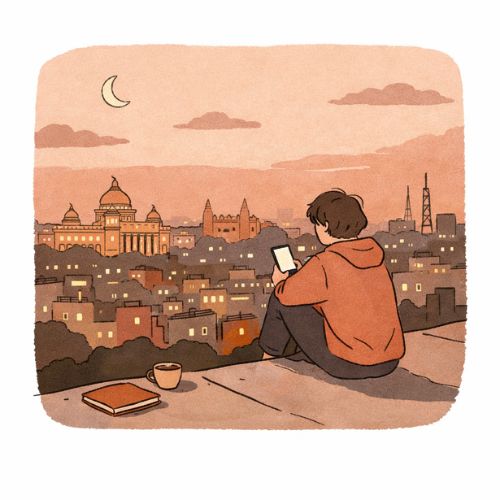
There's a specific kind of loneliness that hits you in Bangalore around age 27.
You're doing fine by every metric that matters. Good job, decent salary, a flat in Koramangala or HSR that you split with a flatmate you found on a Facebook group. You have colleagues you eat lunch with. You have a WhatsApp group from college that sends memes. You have 1,200 Instagram followers.
And yet. On a Saturday evening, when the work adrenaline wears off and the apartment gets quiet, you realise you don't have anyone to call. Not someone who'd actually pick up. Not someone who knows how your week really went — not the curated version, the actual version.
This isn't a personal failing. It's a structural problem. And understanding why it happens is the first step to fixing it.
The science: your social life peaked and you didn't even notice
Researchers at Aalto University and the University of Oxford found that social networks peak around age 25, then steadily shrink. At 25, the average person contacts between 17 and 19 people per month. By 39, that drops to 12–15. The decline starts right when you think adult life is just getting started. You can read a summary of the study on Aalto University's site: "New study shows how age and sex affect the social activity".
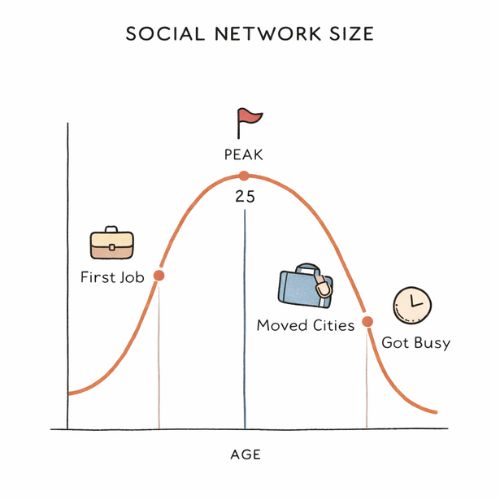
Why 25? Because that's when the three ingredients of organic friendship disappear almost simultaneously.
Sociologist and psychologist Marisa Franco, author of Platonic, identifies what those ingredients are: continuous unplanned interaction, shared vulnerability, and repeated proximity. Think about it — school gave you all three without you lifting a finger. You sat next to the same people every day, complained about the same teachers, and had nowhere else to be. Friendships weren't built. They just happened.
After 25, none of that is automatic anymore.
Research suggests it takes roughly 50 hours of contact to form a casual friendship and around 200 hours to develop a close one. That's a staggering number when your average weeknight involves a 90-minute commute home, reheated food, and a Netflix show you're too tired to actually follow.
The Bangalore multiplier: why this city makes it worse
Everything the research describes gets amplified in Bangalore. This city has a unique cocktail of factors that make adult friendship harder than almost anywhere else in India.
The migration churn. Bangalore absorbs millions of young professionals every year — roughly 10 million enter India's workforce annually, with a huge share landing in cities like Bengaluru, Pune, and Hyderabad. Most change jobs and cities every 18 to 24 months. Your potential friend pool is constantly rotating. The colleague you finally got close to? They moved to Gurugram. The flatmate who got you? Their lease ended.
The commute tax. Bangalore's infrastructure extracts a social tax that's hard to overstate. When getting from Whitefield to Indiranagar takes 90 minutes on a good day, "let's grab a coffee" becomes a logistical operation. Spontaneity — one of the key ingredients of friendship — dies in traffic.
The work-sleep-party loop. India's working young, particularly the 25–35 age bracket, are increasingly caught in what researchers describe as a work-sleep-party routine. Long office hours followed by weekend recovery, occasionally punctuated by a brewery night that's loud enough to prevent any real conversation. You're socialising, technically. But you're not connecting.
The loneliness numbers are staggering. A survey across 14 Indian firms found that 56% of young workers openly admit to feeling lonely, with another 23% experiencing it but in denial. An Ipsos global survey found that 43% of urban Indians report feeling lonely regularly — placing India among the top three countries worldwide for reported loneliness. This isn't a niche problem. It's an epidemic hiding in plain sight.
The five walls between you and actual friendship
So why can't smart, social, well-intentioned people in their late 20s just… make friends? After running 10+ in-person friendship pilots in Bangalore over 11 months before building Somo Club, here's what I observed repeatedly:
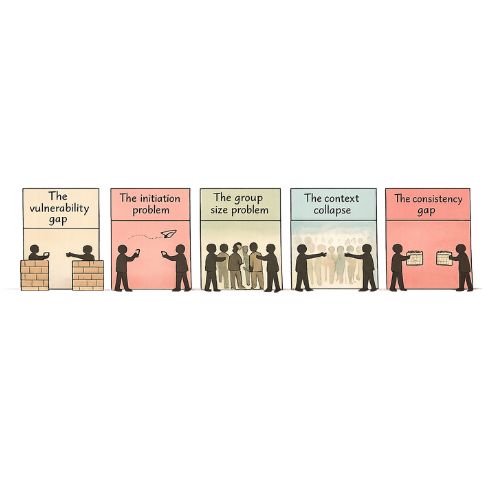
Wall 1: The vulnerability gap
You know how to network. You know how to make small talk at a house party. But friendship requires something fundamentally different: letting someone see you before you've polished the presentation. Adults have spent years building a curated self — on social media, at work, in dating. Dropping that armour with a stranger feels dangerous. So everyone stays pleasant, and nobody gets close.
Wall 2: The initiation problem
Even when you meet someone you click with, someone has to make the first move. And adults are terrified of seeming needy. "Let's hang out sometime" is the adult equivalent of "we should do this again" — a sentence that means nothing because nobody follows up. Research confirms we consistently overestimate the risk of rejection when reaching out. But knowing that doesn't make the text any easier to send.
Wall 3: The group size problem
This one surprised me the most during our pilots. One-on-one meetups with strangers feel like interviews. Large groups feel like parties where you hover at the edges. The sweet spot, we discovered after testing everything from pairs to groups of 12, is six. In a group of six, there's enough social safety that no single person has to carry the conversation, but it's small enough that everyone gets heard. Nobody gets left out. Connections form naturally. This was one of the most important insights from our pilot phase — small, structured groups unlock vulnerability in a way that large, unstructured gatherings simply don't.
Wall 4: The context collapse
Bangalore gives you plenty of ways to "meet people" — brewery nights, run clubs, meetup groups. But most of these environments collapse all social contexts into one: you're surrounded by strangers with no shared frame of reference, no shared experience, and no reason to move past the "so what do you do?" script. Without a shared emotional context — something to react to together — you're just making small talk in a louder room.
Wall 5: The consistency gap
You go to one event. You meet someone interesting. You exchange numbers. And then life happens. There's no second touchpoint. No third. The research on 50 hours to friendship isn't just about total time — it's about regular time. Friendship needs rhythm, not just a single spark. Most social experiences in Bangalore are one-off events with no built-in reason to come back.
What actually works: lessons from the data
After studying this problem obsessively — first through 11 months of real-world pilots, then through running Somo Club with 150+ users in Bangalore since November 2025 — here's what the data says actually moves the needle:
Structure beats spontaneity. Franco's research recommends regularly scheduled group activities over hoping for serendipity. Our data confirms this: users who attend even one IRL meetup show dramatically higher retention and engagement than those who only interact online. The meetup doesn't have to be fancy. It just has to be regular and small enough for real conversation.
Shared vulnerability before shared space. Most friendship solutions put you in a room and hope chemistry happens. We've found the opposite works better: give people a reason to be vulnerable before they meet. Daily conversation prompts — the right kind, not icebreaker trivia — create a foundation of shared honesty that makes the in-person meeting feel like you already know each other. When you've read someone's answer to "What's the hardest lesson life taught you?" before sitting across from them at a café, the small talk evaporates.
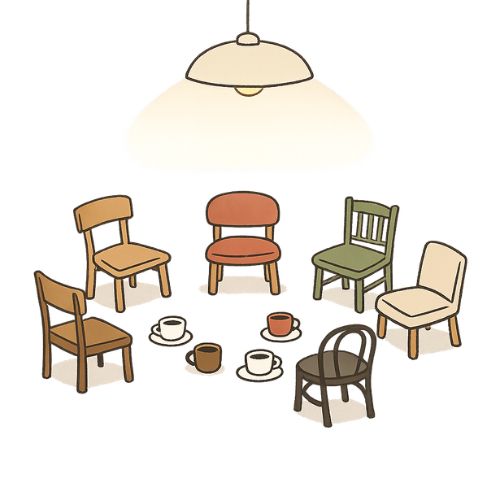
Small groups, high frequency. Groups of six, meeting regularly, with shared context from prior interaction. That's the formula. Not massive events. Not one-on-one pressure. Six people who already know something real about each other, in a space designed for conversation, not performance.
Local context matters. The most engaging conversations in our community are the hyper-local ones. "The Bangalore you love vs. the Bangalore Instagram thinks exists" generates ten times more engagement than any abstract philosophical question. Shared place creates shared identity. This city — with all its contradictions, its filter coffee and its traffic, its darshinis and its microbreweries — is actually one of the most powerful friendship accelerants we have. We just need to use it.
So what do you do now?
If you're reading this at 11 PM on a weeknight in your Bangalore flat, feeling that specific kind of lonely — the kind where you're not alone but you're not known — here's what I'd say:
First, stop blaming yourself. The deck is structurally stacked against adult friendship in cities like this. The research is clear, and your experience is shared by literally millions of people your age in this country.
Second, stop waiting for it to happen organically. It won't. Not because you're doing something wrong, but because the organic conditions — the unplanned interaction, the repeated proximity, the shared vulnerability — no longer exist in your daily life. You have to build them intentionally.
Third, start small. You don't need 20 new friends. You need three people who actually know you. Research consistently shows that the quality of friendships matters far more than the quantity.
That might mean joining a community like Somo Club, where the hard parts — the vulnerability, the structure, the small groups, the consistency — are built into the product. Or it might mean texting that colleague you've been meaning to get coffee with and actually following through this time. Or bringing a real question to your next social gathering instead of defaulting to "so what's new?"
The point is: friendship after 25 in Bangalore is hard. But it's not impossible. It just requires the one thing that nobody tells you — that it's okay to need it, and it's worth building it on purpose.
Tarun Sasikumar is the founder of Somo Club, a social app helping young adults in Bangalore build real friendships through daily conversation prompts, AI-powered personality insights, and IRL meetups in groups of 6. He built it after experiencing urban loneliness firsthand — and after 10+ pilots proved that the right structure can make friendship feel effortless again.
Build your Bangalore inner circle
Somo Club is a social app helping young adults in Bangalore build real friendships through daily conversation prompts, AI-powered personality insights, and IRL meetups in groups of 6.
Join Somo Club →